
The Spa Whisperer: Nigel Franklyn's Secret Sauce of Calmfidence

Updated: Sep 4
PORTRAIT. Nigel Franklyn. Written by the Editorial Team.
There are people who walk into a room and immediately shift its energy. Nigel Franklyn is one of them.
Founder of The Spa Whisperer, Co-Founder of Moss Wellness Consultancy, Creative Director and Advisory Board Member of the Touchless Wellness Association, Nigel Franklyn is one of the most distinctive voices in global luxury wellness today.
He has shaped award-winning spa and wellness concepts for elite hotel groups and private investors across the world, visiting 113 countries in the process, most of them more than once. His work sits at the precise intersection of neuroscience, human-centred design, longevity science, and what he simply calls the art of making people feel safe.
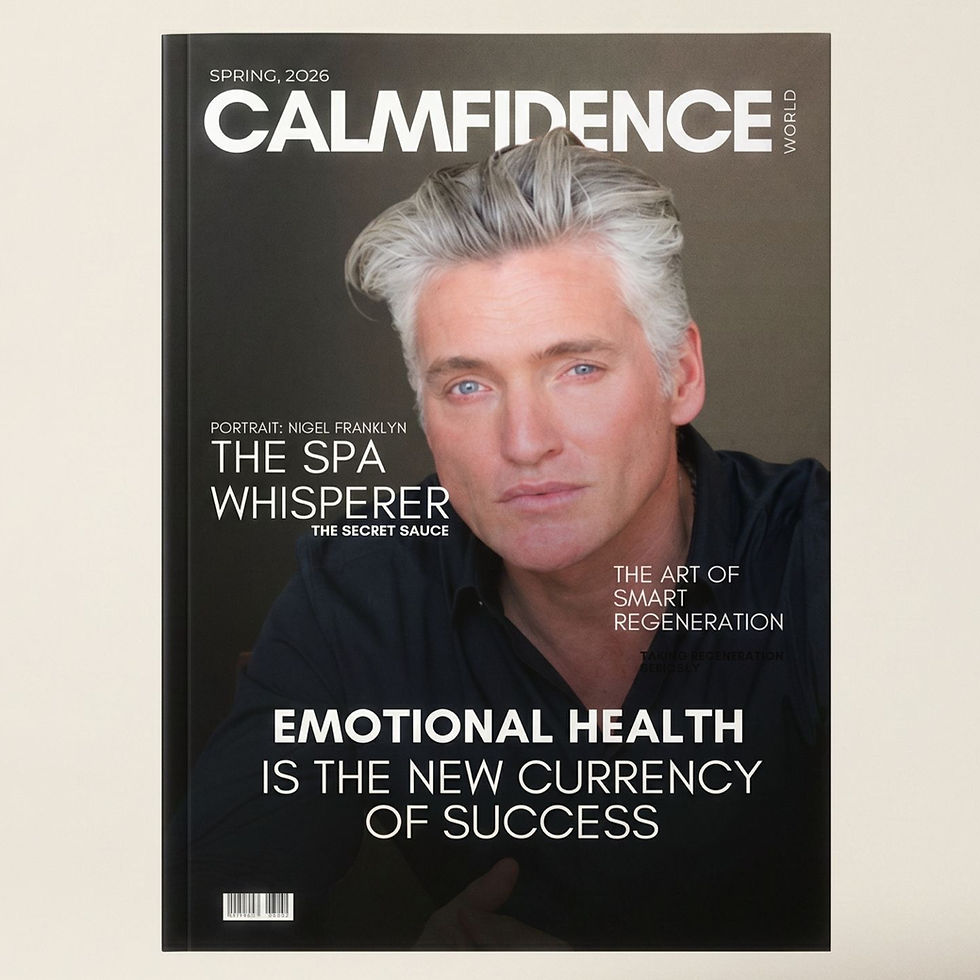
He has spent 26 years building spaces where three specific things happen: a person surrenders completely, feels genuinely safe, and feels truly wanted. It sounds deceptively simple. In practice, it is the work of a lifetime.
He is a man who meditates twice a day before most people have had their first coffee, reads Rumi by lamplight at nine thirty each evening, and will tell you with complete sincerity that his Thai massage therapist in Munich answered her phone mid-treatment, and that he loved every second of it.
He calls himself a wellness alchemist. Those who work with him call him the Spa Whisperer. But underneath the warmth, the wanderlust, and the extraordinary creative intelligence, Nigel Franklyn's story begins with loss, and it is precisely that loss that lit the fire still burning in him today.
From Journalist to Wellness Alchemist
Nigel began his professional life as a journalist. He studied at Sussex University, completed his bachelor's and master's degrees, and two weeks after graduating, moved to California, where he would spend the next 35 years without losing a single syllable of his British accent.
The transition into wellness was not a plan. It was a single encounter.
He was sent to write about the opening of a spa resort. He was given a treatment. And the therapist who worked on him, a woman named Margaret, altered the entire trajectory of his existence.
"I remember everything about her," he says. "The sound of her voice, her kindness, what she was wearing, her lipstick, her teeth. She lived in the house she was born in. She was completely untouched by the world. And she made me feel safe and wanted."
He came away and wrote not about the spa, nor about the treatment itself, because he cannot remember the treatment, but about the power of one person to make a complete stranger feel safe and wanted. Then he became a therapist, because that is what he wanted to give others. That naturally became spa consultancy, which became wellness development, which became what he does today: designing immersive, multi-layered wellness concepts for some of the world's most prestigious hotel groups, across India, Greece, the Middle East, and far beyond.
He has never forgotten what Margaret showed him: that the most sophisticated wellness architecture in the world rests on a foundation of three things. A person must feel safe. A person must feel wanted. And a person must be given somewhere to surrender. "Because spas are very confronting," he says. "You're naked, you have no make-up, your hair's a mess. To build an environment that feels supportive when a person feels vulnerable, that is a really beautiful thing."
That has remained his compass for 26 years.
A Drive Born in Loss
Nigel's parents died when he was young. Rather than folding inward, something in him turned outward: a compulsion toward others, toward healing, toward making people feel less alone in the world.
"I've always been very driven to help," he says. "I don't know where that necessarily comes from."
He does not need to know. The evidence is in the life he has built. What began as a child's response to grief became the central axis of an extraordinary global career. That drive has never once dimmed. If anything, it has grown more refined with time.
The Art of the Vortex
Nigel is candid about why he stands where he stands in his field.
"When I started, wellness wasn't even a word," he says. "There was spa. We were building spas in basements, in laundry rooms in hotels. It just wasn't a thing. I've been very fortunate to have grown up as the industry has grown up. I've evolved as the industry has evolved."
He also grew up as a disruptor. Not for the sake of disruption, he is quick to clarify, but because 26 years of watching an industry mature gives a person a particular kind of authority: the authority to say, clearly and without apology, when something is heading in the wrong direction.
He wrote an article called The Wellness Paradox, examining the over-commodification of wellness: the cycle by which trend lists generate capital expenditure, spas invest, and twelve months later the same machinery demands reinvestment in something new.
"Wellness isn't a trend," he says firmly. "When wellness evolves, it evolves as a shift, a movement, an evolution of consciousness, of awareness. Those shifts don't come every year."
He is equally clear about the word being weaponised in ways that dilute its power. Longevity, he says, is a genuine evolution in human understanding of health and ageing. But it has been borrowed by marketers and made trendy in ways that obscure its real depth. He works with the Touchless Wellness Association for precisely this reason: to distinguish evidence-based practice from what he calls, simply, snake oil.
"Your talent goes a long way," he says, "but your personality goes a long way too. When you talk about your work with passion, it creates a vortex, and people get pulled into the vortex."
That vortex is not manufactured. It cannot be. Nigel is emphatic that passion is the engine, not the performance. He has never worked for anyone else in a traditional sense. He could not.
"I love being an entrepreneur. I love finding business, creating business. The idea of being self-employed, I couldn't operate in any other way."
His interviewer called him a Freigeist, a free spirit. He accepted the description with a grin.
"If you're doing it just for the money, there's no vortex. Passion is what pulls people in."
Wellness as Alchemy
Nigel's concept development work goes far beyond the treatment menu. He is a student of neuroscience, architectural psychology, human behavioural science, and what he calls nudge design: the way shapes, colours, shadows, air quality, sound frequencies, and the movement of sunlight across a space can passively and powerfully shift human wellbeing.
"My initial concepts are very text-heavy," he says, "because the research I do is deep, deep, deep. The concepts I create have to speak to different people in different languages, whether that's a colour, a shape, the design itself."
His journalism background, he says, is where the investigative rigour comes from. He does not approach a new project with a pre-existing aesthetic. He goes in as a researcher. He uncovers what a place, a culture, and a guest population actually need, and then builds something that holds both the familiar and the unknown.
"There always has to be something recognisable for people to hold on to," he explains. "Because wellness at its most perfect state is metamorphic. It's transformational. And for somebody to transform, there has to be something they can reach for. Something they know."
He uses the example of a spa menu. Offer too many unfamiliar treatments and guests panic quietly, then choose a Swedish massage because it is the one thing they recognise. "Nobody wants to feel like an idiot," he says. "And in wellness, panic is your enemy. You want people to find not just themselves, but their potential."
The core of what he builds, he says, is always human design. The science is the scaffolding. The soul is the architecture.
"I don't create a concept based purely on an intervention, like a massage," he says. "I build one thing on top of the other, on top of the other. That's the alchemy."
Wellness Beyond the Walls
What distinguishes Nigel's work most profoundly is not the scale of the projects, though some span ten thousand acres, but the regenerative philosophy that holds them together.
"Sustainability, for me, just means not making things worse," he says. "Regeneration means actively making things better."
His work in India illustrates this most clearly. He has multiple projects there, including a major collaboration with the Oberoi Group, one of India's most distinguished luxury hospitality brands. For Nigel, placing a palatial wellness retreat into the Indian countryside without connecting it meaningfully to the surrounding community would be, as he puts it, cold and bleak. A spaceship that has landed and taken nothing from the experience of what surrounds it.
Instead, he builds ecosystems. Community employment. Local craft partnerships. He works with a company that goes into some of India's poorest villages, teaching women and children how to make thread, skills that translate into income, independence, and dignity.
"I get emotional when I talk about it," he says, voice quieter. "Those women and children now have a way to make money and provide for their families."
He is drawn to clients whose values match his own. His current major Indian project became personal to him quickly. "The reason I took it on is because of her philanthropy work," he says of his client. "She is not a rich woman doing good things. She is a good woman with money. And that distinction matters enormously to me."
The ripple effect of this work extends far beyond any treatment room. It is, perhaps, the most complete expression of what Nigel means when he says wellness cannot exist in isolation.
The Bright Space
You cannot give what you do not have. This is something Nigel knows not just intellectually, but viscerally. His early life, he says, was deeply troubled. The process of learning to find and maintain what he calls his bright space, his most resourceful, joyful, grounded self, has been the real work of his life.
His daily architecture for maintaining that light is both disciplined and deeply personal.
He has practised Transcendental Meditation for over fifteen years. His first session begins at five thirty in the morning, even on nights when he has not slept until three thirty. His second is at three thirty in the afternoon. These are not negotiable. They are the structural foundation of everything else.
When flotation tanks are available, he uses them. When they are not, he showers in complete darkness, essential oils dropped onto the floor, warm water, silence, and a deliberate suspension of all the noise of being Nigel Franklyn. He describes it as neither going inward nor outward, but something more mysterious: expanding into the environment, into the universe itself.
"If I'm stressed, I do it. If I'm tired, I do it. If I feel emotional, I do it," he says. "It's a total reset."
At nine thirty each evening he is in bed, reading poetry by candlelight. Rumi. Ezra Pound. Pablo Neruda. Paper books, always, at the bedside, never his work reading, which stays at the desk. There is ceremony in this, he notes. Ceremony gives meaning. It marks the transition from output to rest.
He is also, he admits freely, an aromatherapy enthusiast, a skincare devotee, and the proud owner of every LED face mask known to humanity. He travels to 113 countries but will happily choose the humble Thai massage place around the corner in Munich over any five-star spa treatment, precisely because the therapist there works so deeply and so insistently that his analytical mind cannot keep up.
"She almost fries my brain," he says, laughing. "There's so much happening that I can't keep up. And that's when I finally relax."
The Heart Place
Beneath all of this architecture of practice is something simpler and more essential: Nigel knows what grounds him.
His husband. His dog Murphy. Their home in Munich.
He calls it his heart place.
"If you lose sense of your heart place, everything else is out of balance," he says. There was a stretch of three consecutive months without a single weekend at home. It was, even for him, too much. He grew fractured, not quite himself.
He learned that lesson the hard way, as he says most important lessons are learned. He now holds his heart place as a priority that sits above his business, because without it he has nothing of real value to bring to anyone.
"You can't drink from a dry well," he says. You can't give people what they deserve unless you've given yourself what you deserve."
What Calmfidence Means to Nigel Franklyn
Asked about his secret, Nigel returns always to the same place: not a technique, not a technology, not a trend. A practice of knowing himself deeply enough to notice when he has drifted, and a toolkit rich enough to find his way back.
He calls it self-mastery. He embedded it this year as a formal component of a longevity concept he launched at Minos Palace in Crete, because he believes, with growing conviction and growing evidence, that self-mastery is inseparable from health span.
"Without understanding who you are, or knowing how to manage yourself, that has a negative impact on everything, longevity included. Nobody talks about self-mastery as it relates to longevity. But they should."
For Nigel, Calmfidence is not a destination. It is a daily practice of orientation, returning, again and again, to the self that is most fully alive. And in a life built entirely around helping others find that same self, the work and the practice are, ultimately, the same thing.
"Anything other than this version of me, and there's always a way to get back to it," he says. "Whether it's stress, anger, exhaustion, I always find a way back."
He pauses.
"I know where my light is. And I keep myself in it."
What He Wants for the Future of Wellness
In a rapidly evolving industry that threatens to lose its soul to technology and trend cycles, Nigel holds a steady, clear-eyed hope: that high touch and high tech will evolve together, not in competition.
"Technology is transactional," he says. "Human connection is transformative. There always has to be a merge of the two."
The more we advance into technology-heavy wellness, he believes, the more we will rediscover the irreplaceable power of genuine human presence, a therapist who truly sees you, a space designed to hold you, a moment of real surrender.
"The evolution of wellness will not come from people who feed the status quo," he says. "It comes from people who disrupt it, challenge it, and fight against it."
He smiles. "That's always going to be where I am."
About Nigel Franklyn
Nigel Franklyn is Founder of The Spa Whisperer, Co-Founder of Moss Wellness Consultancy, Creative Director, and Advisory Board Member of the Touchless Wellness Association. He is a globally recognised luxury spa and wellness developer, concept creator, and industry thought leader, based in Munich.
What's next
Continue with Brigitte Macron: The Calmfidence of France’s First Lady, a related read on this topic.
Explore our Interview collection for more evidence-based perspectives.
For the studies behind this series, browse our Lifestyle Medicine Research Hub, where each study is summarised in plain language.
Curious to explore more?
Join the Calmfidence Circle, a community of high-achieving women and midlife leaders dedicated to emotional health, sustainable success, lifestyle medicine and vital regeneration. Receive curated Calmfidence insights, delivered quietly to your inbox.
Want to be featured in exclusive Icon Insights interview?
Explore how your expertise can gain greater visibility and media exposure.
Calmfidence World. From depletion to Calm Power.


