
Overcoming Self-Doubt: Your Path to inner Calm and authentic Confidence

Updated: Nov 15
Self-doubt can often feel like an unwelcome companion, quietly lurking in the shadows and whispering negative thoughts about our worth and capabilities. You’re not alone if you find yourself questioning whether you’re good enough, whether you’re doing enough, or whether you have the capacity to succeed at something that truly matters to you. It’s a pervasive struggle, but it doesn’t have to define your journey.
She is drafting the proposal when the quiet voice arrives: who are you to put your name on this?

For You, our courageous Captain, the journey hasn’t always been smooth sailing. Your ship is strong, built from years of experiences, lessons, and deep-rooted values, but there’s another force at play: your inner crew that isn’t always cooperative. This inner crew represents different aspects of your inner world. There’s the Indecisive Mate, who constantly second-guesses every decision, filling her mind with doubts and confusion.
The Inner-Critic Bosun stands ready to point out every flaw, every potential mistake. The Self-Doubt Deckhand questions whether she has what it takes to stay on course. And then there’s the Negative Self-Talk voice, whose pessimistic directions steer the ship off course, away from the true path. At times, these unruly inner crew members have tried to take over the wheel, steering You away from your intended course. They’ve made You question your abilities, your decisions, and even your worth as a Captain.
The four steps of the Core Calmfidence® System are Capital, Clarity, Congruence and Choice. By engaging with these four pillars, you can cultivate unwavering self-belief, confidence and self-love, supporting the life you want. Each step comes with practical examples to help you navigate your path to calm and confidence.
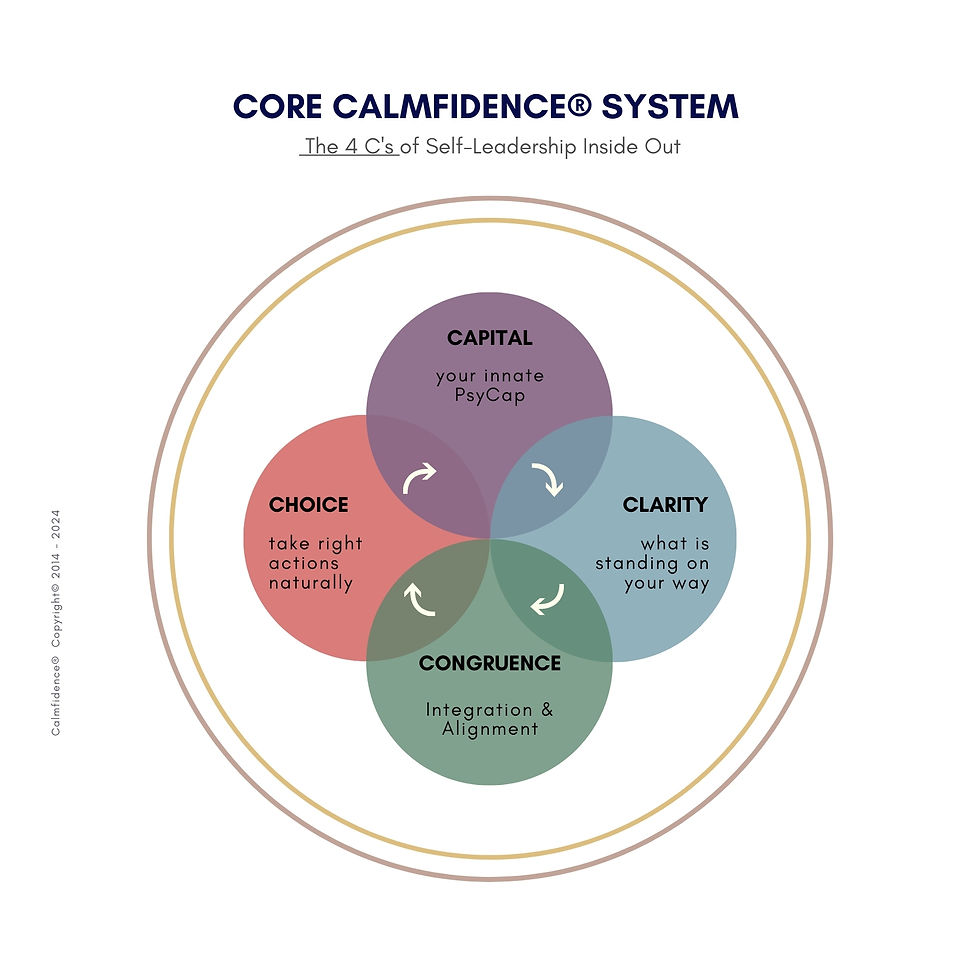
You probably already know that for your Core Self to operate at its full potential, your mind, body and soul need to be balanced and in a flow state of inner Calm and authentic Confidence. This is what we call a state of Calmfidence. The Core Calmfidence® System is a simple framework designed to help you, the Captain, reclaim the helm and steer your life with clarity, purpose and unwavering Calmfidence, no matter what challenges arise.
Capital (Psychological Capital)
The first step, Capital, focuses on identifying and leveraging your unique strengths and resources. Think of these as your personal assets: the qualities, experiences, and skills that set you apart. Self-doubt often clouds our ability to recognise these assets, leading us to overlook our potential.
Psychological Capital refers to your inner psychological resources: courage, creativity, resilience, and emotional intelligence. As an entrepreneur, you already possess these qualities, but you may not always recognise or tap into them effectively. By identifying and leveraging your inner capital, you can unlock a reserve of strength that enables you to persevere, innovate, and lead with conviction.
Consider an illustrative example: Sarah, the founder of a tech start-up, found herself struggling with self-doubt after multiple setbacks during the product development phase. Through the Core Calmfidence® System she learned how to tap into her Capital: her passion for the project, her ability to problem-solve, and her creativity. By shifting her focus from what was going wrong to what she could control and harness internally, Sarah reignited her confidence. As a result, she brought fresh ideas to the table, re-engaged her team, and secured the investment needed to take her company to the next level.
Identify Your Strengths
To begin, take a moment to reflect on what you excel at. Write down a list of your skills, achievements, and experiences. These could range from professional skills to personal attributes like empathy, creativity, or resilience.
Consider Maria, a graphic designer who has always struggled with self-doubt. Despite receiving positive feedback on her work, she often downplayed her abilities. One day, she decided to create a portfolio showcasing her best projects. By visually documenting her accomplishments, she began to recognise the value she brought to her field. This shift in perspective became a significant source of confidence.
Clarity
The second step, Clarity, is about gaining a deeper understanding of your thoughts and emotions. Self-doubt often thrives in confusion and uncertainty. By achieving clarity, you can better navigate your feelings and develop a clearer vision of your goals.
Clarity, the second pillar of the Core Calmfidence® System, is about understanding and recognising your inner team, which we call your Inner Parts. These Inner Parts are like crew members on a ship, each with their own roles, concerns, and perspectives. Some Parts contribute to your emotional strength and resilience, adding to your Psychological CAPITAL (pillar one), while others deplete it, standing in the way of your progress. In business, emotions like fear, frustration, and doubt can easily overwhelm you, clouding your decision-making and impeding progress.
With Clarity, you can observe and gain a deep awareness of which Parts are helping you stay calm, confident, and focused, and which are dragging you down with doubt, fear, or frustration.
In the fast-paced world of entrepreneurship, it's easy to lose sight of these dynamics and allow unproductive Parts to take over, leading to stress, poor decision-making, and burnout. By knowing your inner team and understanding how each Part impacts your mindset, you can consciously manage your internal resources and make choices that support your long-term success. It's about building a deeper awareness of your inner landscape, your Inner Parts, and understanding how these sub-personalities shape your responses to pressure, uncertainty, and stress. Each of us has a team of internal voices or Parts: the anxious Part, the critical Part, the impatient Part, and even the calm, confident Part.
These Parts represent different aspects of our psyche, and when left unmanaged, they can create chaos, especially under the mounting pressures of entrepreneurship. But how do you stay calm and grounded in the face of this internal and external chaos? How do you lead your business with focus and confidence when your Inner Parts are pulling you in different directions?
The answer lies in mastering your Inner Parts: what we refer to as your inner crew. Much like a captain navigating a ship, you must first understand and trust your crew to steer your business with clarity and wisdom.
Remaining calm amidst chaos is an art that springs from the mastery of your Inner Parts.
Journaling for Insight
A powerful tool for gaining clarity is journaling. Set aside time each day to write about your thoughts, feelings, and experiences related to self-doubt. This practice allows you to externalise your internal conflicts and can reveal patterns or triggers that contribute to your self-doubt.
Consider John, an aspiring entrepreneur, who struggled with feelings of inadequacy whenever he considered pitching his business idea. After a week of journaling, he noticed that these feelings often arose when he compared himself to more experienced business owners. Recognizing this pattern allowed him to consciously shift his focus back to his unique journey and strengths.
Visualise Your Goals
In addition to journaling, visualisation can enhance clarity. Picture yourself achieving your goals and the steps you need to take to get there. This exercise builds motivation and helps clarify what success looks like for you.
Congruence
The third step, Congruence, emphasises the importance of aligning your actions with your values and beliefs. When there’s a disconnect between who you are and what you do, self-doubt can easily take root.
The third pillar of the Core Calmfidence® System, Congruence, focuses on resolving the internal conflicts within your Inner Parts. These conflicts often arise when different Parts of you, such as the critical, fearful or anxious Parts, are at odds with one another, creating tension and emotional blocks that can hinder your progress. As an entrepreneur, these internal battles can leave you feeling stuck, unsure, or overwhelmed, and can ultimately drain your energy and resilience.
The Congruence intervention of the Core Calmfidence® System provides tools to heal these internal conflicts, helping you to align your thoughts, emotions, and actions with your true goals. Congruence is about healing the internal barriers that keep you stuck in a cycle of self-doubt or indecision. Once these barriers are removed, you can lead your business from a place of self-trust and authentic power.
Consider an illustrative example: Emma, a founder in the health-tech sector, who struggled with constant imposter syndrome despite her company’s growth. She felt paralysed by the fear of making the wrong decision, which led her to avoid taking bold actions. Through this intervention, Emma confronted the underlying causes of her self-doubt and recognised that her fears came from deeply ingrained limiting beliefs. By working through this, she was able to resolve her inner conflict and make strategic decisions with newfound confidence. This shift allowed her to expand her company’s offerings and secure partnerships that had previously felt out of reach.
By addressing the unresolved emotions and beliefs within your inner team, you create space for curiosity, connectedness, confidence and courage to emerge from within. These qualities support you in bringing your vision into the outer world, whether that vision is personal or professional. When you resolve internal conflicts and align your inner Parts, the benefits extend beyond your personal wellbeing. As you heal and strengthen your internal foundation, your Core Self comes forward as a force multiplier within your family, community and organisation. Your newfound balance and confidence inspire and uplift those around you.
Assess Your Values
Begin by identifying your core values. What principles are non-negotiable for you? These could include honesty, creativity, community, or personal growth. When your actions align with these values, you’re more likely to feel confident and fulfilled.
Consider Sarah, a teacher, who found herself feeling overwhelmed and doubting her abilities when forced to adhere strictly to standardised testing protocols. After reflecting on her values, she realised that fostering creativity and critical thinking in her students was paramount. By integrating more project-based learning into her curriculum, she felt more aligned with her values and, consequently, her confidence grew.
Reframe Your Mindset
Once you have identified your strengths, the next step is to reframe your mindset. Instead of viewing self-doubt as a permanent fixture, consider it a signal that you have untapped potential waiting to be realised. Start a daily affirmation practice. Each morning, recite a list of your strengths and remind yourself that you have what it takes to succeed. Over time, this simple practice can transform your inner dialogue and diminish feelings of inadequacy.
Choice
The final step, Choice, emphasises the power of decision-making in overcoming self-doubt. Every choice you make, no matter how small, can lead you toward a more confident version of yourself. It represents the culmination of all the work done in the previous pillars. When your Inner Parts are aligned, centred, and supportive, your inner power multiplies with laser-like focus. This internal harmony allows you to take decisive actions toward your goals without being held back by fear, distractions, inner battles, self-sabotage, or procrastination. When all your Parts work in harmony, your natural brilliance, the built-in blueprint of your true self, activates consistently, by default. This alignment empowers you to create a purpose-driven life. You no longer need to force decisions or struggle with self-doubt. Instead, you find yourself naturally flowing with opportunities, moving toward your goals with clarity and confidence.
Make Empowered Choices
Once you have clarity on your values, it’s essential to make choices that resonate with them. This could involve setting boundaries, pursuing opportunities that align with your passions, or even reevaluating relationships that contribute to your self-doubt. Create a decision-making framework based on your values. When faced with a choice, ask yourself: “Does this align with who I am and what I believe?” This practice helps ensure that your actions are congruent with your true self, bolstering your confidence in the process.
Embrace Growth Mindset
Adopting a growth mindset is essential in this step. Understand that challenges and failures are opportunities for learning and growth rather than reflections of your worth. This perspective empowers you to take risks and make choices that align with your aspirations.
Consider David, an artist, who initially hesitated to showcase his work for fear of criticism. However, he decided to embrace a growth mindset and applied to a local art exhibit. Regardless of the outcome, he viewed the experience as a chance to learn and grow. The positive feedback he received ignited a newfound confidence that propelled him to pursue further opportunities.
Take Incremental Steps
Big changes can feel overwhelming and trigger self-doubt. Instead, focus on taking small, incremental steps toward your goals. As you accomplish these tasks, take time to acknowledge and celebrate your progress.
Overcoming self-doubt is a journey that requires patience, self-compassion, and commitment to personal growth. In the book CALMFIDENCE IS THE KEY the book by Nell Puetter shows how leaders can cultivate a deep sense of self-belief and confidence. Remember, you are not alone in your struggle with self-doubt, and the path to self-love and confidence is within your reach. Embrace it, step by step, with Calmfidence.
FAQ
What is the Core Calmfidence System's approach to overcoming self-doubt?
A four-step framework, Capital, Clarity, Congruence and Choice, designed to help you identify your strengths, understand your inner emotional dynamics, resolve internal conflict, and make decisions that build unwavering self-belief.
What does the Capital step involve?
Identifying and leveraging your unique strengths, experiences and psychological resources such as courage, creativity and resilience, since self-doubt often clouds your ability to recognise these assets in the first place.
How does journaling help with self-doubt?
Journaling externalises internal conflicts and can reveal the patterns or triggers behind self-doubt, illustrated by an aspiring entrepreneur who noticed his feelings of inadequacy consistently arose when comparing himself to more experienced business owners.
What is Congruence and why does it matter?
Congruence means aligning your actions with your values and beliefs; when there is a disconnect, self-doubt takes root. An illustrative example shows a founder who resolved imposter syndrome by recognising that her fears were rooted in limiting beliefs.
What practical steps does the Choice pillar recommend?
Making choices that resonate with your identified values, adopting a growth mindset that treats setbacks as learning opportunities, and taking small incremental steps toward goals.
What is a simple daily practice for shifting self-doubt?
A daily affirmation practice: each morning, reciting your identified strengths and reminding yourself you have what it takes, which over time can shift your inner dialogue and diminish feelings of inadequacy.
What are Calmfidence® and Core Calmfidence®?
Calmfidence® is a term coined by Nell Pütter for the emotional state of being calm and confident at the same time. Core Calmfidence is an inside-out sense of inner Calm Power that is independent of anything or anyone.
What's next
Continue with Confidence vs. Self-Esteem: Why You Can Have One Without the Other, a related read on this topic.
Explore our Self-Sabotage collection for more evidence-based perspectives.
For the studies behind this series, browse our Lifestyle Medicine Research Hub, where each study is summarised in plain language.
Calmfidence. From Pressure to Calm Power


